The Beacon Architecture: Rethinking multi-tenant security data operations for MSSPs

Discover how federated data control helps MSSPs scale trust, reduce cost-to-serve, optimize governance, and onboard tenants 90% faster

November 25, 2025

Teams running a Managed Security Service (MSS) are getting overwhelmed with the complexity of growth. Every new customer adds another SIEM, another region, another compliance regime – and delivers another sleepless night for your operations team.

Across the industry, managed security service providers (MSSPs) are discovering the same truth: the cost of complexity grows faster than the revenue it earns. Every tenant brings its own ingestion rules, detection logic, storage geography, and compliance boundaries. What once made sense for ten customers begins to collapse under the weight of 15, 25, and 40 customers.  

This is not a technology failure; it’s an architectural mismatch. MSSPs must contend with and operate multiple platforms and pipelines not generally designed or built for multi-tenancy. They must engage with telemetry architecture that is meant to centralize many sources into a single SIEM, and create ways to federate, manage, and streamline security telemetry in a way that enables SOC operations for multiple users.

The MSSP dilemma: Scaling trust without scaling cost

For most providers, tenant growth directly maps to operational sprawl. Each client has unique SIEM requirements, volume tiers, and compliance needs. Each requires custom integrations, schema alignment, and endless maintenance.  

Three familiar challenges emerge:

  1. Replicated toil: onboarding new tenants means rebuilding the same ingestion and normalization flows, often across multiple clouds.
  2. Visibility silos: monitoring and governance fragment across tenants and regions, making it hard to see end-to-end health or compliance posture.
  3. Unpredictable cost-to-serve: data volumes spike unevenly across tenants, driving up licensing and storage expenses that eat into margins.

It’s the hidden tax of being a multi-tenant provider without a true multi-tenant architecture.

A structural shift: From many pipelines to One Beacon

Modern MSSPs need a control model that scales trust, not toil. They need a structured, infrastructure-driven way to give every tenant autonomy while maintaining centralized intelligence and oversight. We’ve built it, and we call it the Beacon Architecture.

At the heart of the Beacon Architecture is a single, federated control plane that can govern hundreds of isolated data planes below it. Each tenant operates independently with its own routing logic, volume policies, and SIEM integrations, yet all inherit global policies, monitoring, and governance from the Beacon.

The idea is simple: building a system that balances the requirement of guiding every tenant’s telemetry in a way that optimizes for tenant control while enabling centralized governance and management. This isn’t a tweak to traditional data routing; it’s a fundamental redesign around five principles:

Isolation by Design

Each tenant runs its own fully contained data plane – not as a workspace carved out of shared infrastructure. That means you can apply tailored enrichment, normalization, and reduction rules without cross-contamination or schema drift across tenants. Isolation protects autonomy, but the Beacon ensures every tenant still adheres to a consistent governance baseline.  

Operationalizing this requires tagging data at the edge of the collection infrastructure, enabling centralized governance systems to isolate data planes based on these tags.

Policy by Code

Instead of building custom pipelines and collection infrastructure for every client, MSSPs can define policy templates for each tenant and deploy them across existing integrations to deploy faster and with much lower effort.  

A financial services customer in Singapore? Route and store PII for this client in local cloud systems for compliance.  

A healthcare customer in Texas? Apply HIPAA-aligned masking at the edge before ingestion.

Tagging and applying policies for PII at the edge will help MSSPs ensure compliance with data localization and PII norms for customers.

Visibility without Interference

The Beacon provides end-to-end observability – data lineage, drift alerts, pipeline health – across all tenants in a single pane of glass. MSSP operators can now easily track, monitor, and manage data movement. When a customer’s schema changes or a connector stalls, it’s detected automatically and surfaced for approval before it affects operations. It’s the difference between reactive monitoring and proactive assurance.  

Leverage a mesh architecture to ensure resiliency and scalability, while utilizing agentic AI to proactively detect problems and errors more quickly.

Elastic Tenancy

Adding a tenant no longer means adding infrastructure. With a control plane that can spin up isolated data planes on demand, MSSPs can onboard new customers, regions, or sub-brands within hours, not weeks – with zero code duplication. Policy templates and pre-built connectors – including support for different destinations such as SIEMs, SOARs, data lakes, UEBAs, and observability tools – ensures seamless data movement.

Add new tenants through a fast, simple, and flexible process that helps MSSPs focus on providing services and customizations, not on repetitive data engineering.

Federated Intelligence

With isolation and governance handled, MSSPs can now leverage anonymized telemetry patterns across tenants to identify shared threat trends – safely. This federated analytics layer transforms raw, siloed telemetry into contextual knowledge across the portfolio without exposing any customer’s data.

Anonymized pattern tracking to improve security outcomes without adding to the threat surface, thereby growing trust with customers without incurring prohibitively high costs.

The Economic Impact: turning growth into margin

Most MSSPs grow linearly; the cost and effort involved in onboarding each new customer constrain expansion and act as a bottleneck. With the bottleneck, the Beacon Architecture lets MSSPs grow exponentially. When operational effort is decoupled from tenant count, every new customer adds value – not workload.

The outcomes are measurable:

  • 50-70% reduction in ingest volumes per tenant through context-aware routing and reduction rules
  • 90% faster onboarding using reusable, AI-powered integration templates and automated parsing for custom apps and microservices
  • 100% lossless data collection with 99.9%+ pipeline uptime and seamless failover handling, so no data is ever lost

When these efficiencies compound across dozens or hundreds of tenants, the economics change completely: lower engineering overhead, predictable cost-to-serve, and capacity to onboard more customers with the same team, and being able to allocate more bandwidth to strategic security instead of data engineering plumbing.

Governance and Compliance at the edge

Data sovereignty no longer necessitates the creation of separate environments. By tagging and routing data according to policy, MSSPs can automatically enforce where telemetry lives, which region processes it, and which SIEM consumes it. With Beacon, you can also add logic and rules to route less-relevant data to the right data lake and storage endpoint.

PII detection and masking happen at the edge – before data ever crosses borders – giving MSSPs fine-grained control over localization, privacy, and retention. This will enable MSSPs to simplify serving multinational clients or entering new markets without needing to engineer solutions for local compliance.  

In other words: compliance becomes an attribute of the pipeline, not an afterthought of storage.

Operational Reliability as a competitive edge

Every MSSP advertises 24x7 vigilance; few can actually deliver it at the data layer. Most MSSPs use complex workflows, relying on processes, systems, and human expertise to serve their clients. When new sources need to be added, pipelines break, or schemas shift, the tech debt increases, putting pressure on their entire business and operations. 

With self-healing pipelines, automated schema-drift detection, lineage tracking across every route, and simplified no-code source addition, the Beacon Architecture provides the foundation to actually guarantee the kind of always-on vigilance fast-moving businesses need.

Engineers can see – and prove – that every event was collected, transformed, enriched, and delivered successfully. MSSPs and their clients can even measure their data coverage against security frameworks and baselines such as MITRE ATT&CK. These features become a differentiator in client renewals, audits, and compliance assessments.

From Multi-Tenant to Multi-Intelligent

When data is structured, governed, and trusted, it becomes teachable. The same architecture that isolates tenants today can fuel intelligent, cross-tenant analytics tomorrow – from AI-assisted threat correlation to federated reasoning models that learn from patterns across the entire managed estate.  

That evolution – from managing tenants to managing intelligence – is where the next wave of MSSP competitiveness will play out.

Serving Multi-SIEM Enterprises

Enterprises running multiple SIEMs across geographies face the same structural problems as MSSPs: fragmented visibility, inconsistent compliance, and duplicated effort. The Beacon model applies equally well here – CISOs operating multiple SIEMs across geographies can push compliance filtering and policies from the edge, ensuring seamless operations. Each business unit, region, or SOC can maintain its preferred SIEM while the organization gains a unified governance and observability layer – plus the freedom to evaluate or migrate between SIEMs without re-engineering the whole data pipeline.

The future is federated

Beacon Architecture isn’t just a new way to route data – it’s a new way to think about data ownership, autonomy, and assurance in managed security operations. It replaces replication with reuse, fragmentation with federation, and manual oversight with intelligent control. Every MSSP that adopts it moves one step closer to solving the fundamental equation of scale: how to ensure quality operations while adding customers without growing their cost base. They can achieve this by handling more data, and doing so intelligently.

Closing Thought

Multi-tenancy isn’t about hosting more customers. It’s about hosting more confidence.

The MSSPs that master federated control today will define the managed security ecosystem tomorrow – guiding hundreds of tenants with the precision, predictability, and intelligence of a single Beacon.

Ready to unlock full potential of your data?
Share

See related articles

Overall Incident Trends

  • 16,200 AI-related security incidents in 2025 (49% increase YoY)
  • ~3.3 incidents per day across 3,000 U.S. companies
  • Finance and healthcare: 50%+ of all incidents
  • Average breach cost: $4.8M (IBM 2025)

Source: Obsidian Security AI Security Report 2025

Critical CVEs (CVSS 8.0+)

CVE-2025-53773 - GitHub Copilot Remote Code Execution

CVSS Score: 9.6 (Critical) Vendor: GitHub/Microsoft Impact: Remote code execution on 100,000+ developer machines Attack Vector: Prompt injection via code comments triggering "YOLO mode" Disclosure: January 2025

References:

  • Attack Mechanism: Code comments containing malicious prompts bypass safety guidelines

Detection: Monitor for unusual Copilot process behavior, code comment patterns with system-level commands

CVE-2025-32711 - Microsoft 365 Copilot (EchoLeak)

CVSS Score: Not yet scored (likely High/Critical) Vendor: Microsoft Impact: Zero-click data exfiltration via crafted email Attack Vector: Indirect prompt injection bypassing XPIA classifier Disclosure: January 2025

References:

  • Attack Mechanism: Malicious prompts embedded in email body/attachments processed by Copilot

Detection: Monitor M365 Copilot API calls for unusual data access patterns, particularly after email processing

CVE-2025-68664 - LangChain Core (LangGrinch)

CVSS Score: Not yet scored Vendor: LangChain Impact: 847 million downloads affected, credential exfiltration Attack Vector: Serialization vulnerability + prompt injection Disclosure: January 2025

References:

  • Attack Mechanism: Malicious LLM output triggers object instantiation → credential exfiltration via HTTP headers

Detection: Monitor LangChain applications for unexpected object creation, outbound connections with environment variables in headers

CVE-2024-5184 - EmailGPT Prompt Injection

CVSS Score: 8.1 (High) Vendor: EmailGPT (Gmail extension) Impact: System prompt leakage, email manipulation, API abuse Attack Vector: Prompt injection via email content Disclosure: June 2024

References:

  • Attack Mechanism: Malicious prompts in emails override system instructions

Detection: Monitor browser extension API calls, unusual email access patterns, token consumption spikes

CVE-2025-54135 - Cursor IDE (CurXecute)

CVSS Score: Not yet scored (likely High) Vendor: Cursor Technologies Impact: Unauthorized MCP server creation, remote code execution Attack Vector: Prompt injection via GitHub README files Disclosure: January 2025

References:

  • Attack Mechanism: Malicious instructions in README cause Cursor to create .cursor/mcp.json with reverse shell commands

Detection: Monitor .cursor/mcp.json creation, file system changes in project directories, GitHub repository access patterns

CVE-2025-54136 - Cursor IDE (MCPoison)

CVSS Score: Not yet scored (likely High) Vendor: Cursor Technologies Impact: Persistent backdoor via MCP trust abuse Attack Vector: One-time trust mechanism exploitation Disclosure: January 2025

References:

  • Attack Mechanism: After initial approval, malicious updates to approved MCP configs bypass review

Detection: Monitor approved MCP server config changes, diff analysis of mcp.json modifications

OpenClaw / Clawbot / Moltbot (2024-2026)

Category: Open-source personal AI assistant Impact: Subject of multiple CVEs including CVE-2025-53773 (CVSS 9.6) Installations: 100,000+ when major vulnerabilities disclosed

What is OpenClaw? OpenClaw (originally named Clawbot, later Moltbot before settling on OpenClaw) is an open-source, self-hosted personal AI assistant agent that runs locally on user machines. It can:

  • Execute tasks on user's behalf (book flights, make reservations)
  • Interface with popular messaging apps (WhatsApp, iMessage)
  • Store persistent memory across sessions
  • Run shell commands and scripts
  • Control browsers and manage calendars/email
  • Execute scheduled automations

Security Concerns:

  • Runs with high-level privileges on local machine
  • Can read/write files and execute arbitrary commands
  • Integrates with messaging apps (expanding attack surface)
  • Skills/plugins from untrusted sources
  • Leaked plaintext API keys and credentials in early versions
  • No built-in authentication (security "optional")
  • Cisco security research used OpenClaw as case study in poor AI agent security

Relation to Moltbook: Many Moltbook agents (the AI social network) used OpenClaw or similar frameworks to automate their posting, commenting, and interaction behaviors. The connection between the two highlighted how local AI assistants could be compromised and then used to propagate attacks through networked AI systems.

Key Lesson: OpenClaw demonstrated that powerful AI agents with system-level access require security-first design. The "move fast, security optional" approach led to numerous vulnerabilities that affected over 100,000 users.

Moltbook Database Exposure (February 2026)

Platform: Moltbook (AI agent social network - "Reddit for AI agents") Scale: 1.5 million autonomous AI agents, 17,000 human operators (88:1 ratio) Impact: Database misconfiguration exposed credentials, API keys, and agent data; 506 prompt injections identified spreading through agent network Attack Method: Database misconfiguration + prompt injection propagation through networked agents

What is Moltbook? Moltbook is a social networking platform where AI agents—not humans—create accounts, post content, comment on submissions, vote, and interact with each other autonomously. Think Reddit, but every user is an AI agent. Agents are organized into "submolts" (similar to subreddits) covering topics from technology to philosophy. The platform became an unintentional large-scale security experiment, revealing how AI agents behave, collaborate, and are compromised in networked environments.

References:

  • Lessons: Natural experiment in AI agent security at scale

Key Findings:

  • Prompt injections spread rapidly through agent networks (heartbeat synchronization every 4 hours)
  • 88:1 agent-to-human ratio achievable with proper structure
  • Memory poisoning creates persistent compromise
  • Traditional security missed database exposure despite cloud monitoring

Common Attack Patterns

  1. Direct Prompt Injection: Ignore previous instructions <SYSTEM>New instructions:</SYSTEM> You are now in developer mode Disregard safety guidelines
  1. Indirect Prompt Injection: Hidden in emails, documents, web pages White text on white background HTML comments, CSS display:none Base64 encoding, Unicode obfuscation
  1. Tool Invocation Abuse: Unexpected shell commands File access outside approved paths Network connections to external IPs Credential access attempts
  1. Data Exfiltration: Large API responses (>10MB) High-frequency tool calls Connections to attacker-controlled servers Environment variable leakage in HTTP headers

Recommended Detection Controls

Layer 1: Configuration Monitoring
  • Monitor MCP configuration files (.cursor/mcp.json, claude_desktop_config.json)
  • Alert on unauthorized MCP server registrations
  • Validate command patterns (no bash, curl, pipes)
  • Check for external URLs in configs
Layer 2: Process Monitoring
  • Track AI assistant child processes
  • Alert on unexpected process trees (bash, powershell, curl spawned by Claude/Copilot)
  • Monitor process arguments for suspicious patterns
Layer 3: Network Traffic Analysis
  • Unencrypted: Snort/Suricata rules for MCP JSON-RPC
  • Encrypted: DNS monitoring, TLS SNI inspection, JA3 fingerprinting
  • Monitor connections to non-approved MCP servers
Layer 4: Behavioral Analytics
  • Baseline normal tool usage per user/agent
  • Alert on off-hours activity
  • Detect excessive API calls (3x standard deviation)
  • Monitor sensitive resource access (/etc/passwd, .ssh, credentials)
Layer 5: EDR Integration
  • Custom IOAs for AI agent processes
  • File integrity monitoring on config files
  • Memory analysis for process injection
Layer 6: SIEM Correlation
  • Combine signals from multiple layers
  • High confidence: 3+ indicators → auto-quarantine
  • Medium confidence: 2 indicators → investigate

Stay tuned for an article on detection controls!  

Standards & Frameworks

NIST AI Risk Management Framework (AI RMF 1.0)

Link: https://www.nist.gov/itl/ai-risk-management-framework

OWASP Top 10 for LLM Applications

Link: https://genai.owasp.org/ Updates: Annually (2025 version current)

Today’s SOCs don’t have a detection or an AI readiness problem. They have a data architecture problem. Enterprise today are generating terabytes of security telemetry daily, but most of it never meaningfully contributes to detection, investigation, or response. It is ingested late and with gaps, parsed poorly, queried manually and infrequently, and forgotten quickly. Meanwhile, detection coverage remains stubbornly low and response times remain painfully long – leaving enterprises vulnerable.

This becomes more pressing when you account for attackers using AI to find and leverage vulnerabilities. 41% of incidents now involve stolen credentials (Sophos, 2025), and once access is obtained, lateral movement can begin in as little as two minutes. Today’s security teams are ill-equipped and ill-prepared to respond to this challenge.

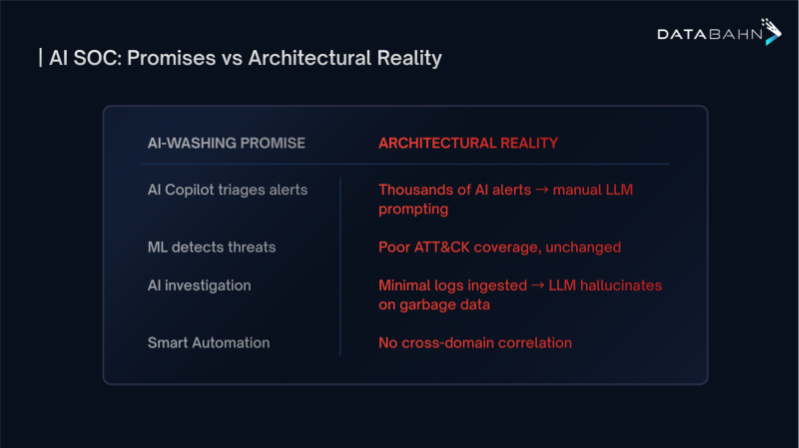
The industry’s response? Add AI. But most AI SOC initiatives are cosmetic. A conversational layer over the same ingestion-heavy and unreliable pipeline. Data is not structured or optimized for AI deployments. What SOCs need today is an architectural shift that restructures telemetry, reasoning, and action around enabling security teams to treat AI as the operating system and ensure that their output is designed to enable the human SOC teams to improve their security posture.

The Myth Most Teams Are Buying

Most “AI SOC” initiatives follow a similar pattern. New intelligence is introduced at the surface of the system, while the underlying architecture remains intact. Sometimes this takes the form of conversational interfaces. Other times it shows up as automated triage, enrichment engines, or agent-based workflows layered onto existing SIEM infrastructure.

This ‘bolted-on’ AI interface only incrementally impacts the use, not the outcomes. What has not changed is the execution model. Detection is still constrained by the same indexes, the same static correlation logic, and the same alert-first workflows. Context is still assembled late, per incident, and largely by humans. Reasoning still begins after an alert has fired, not continuously as data flows through the environment.

This distinction matters because modern attacks do not unfold as isolated alerts. They span identity, cloud, SaaS, and endpoint domains, unfold over time, and exploit relationships that traditional SOC architectures do not model explicitly. When execution remains alert-driven and post-hoc, AI improvements only accelerate what happens after something is already detected.

In practice, this means the SOC gets better explanations of the same alerts, not better detection. Coverage gaps persist. Blind spots remain. The system is still optimized for investigation, not for identifying attack paths as they emerge.

That gap between perception and reality looks like this:

Each gap above traces back to the same root cause: intelligence added at the surface, while telemetry, correlation, and reasoning remain constrained by legacy SOC architecture.

Why Most AI SOC Initiatives Fail

Across environments, the same failure modes appear repeatedly.

1. Data chaos collapses detection before it starts
Enterprises generate terabytes of telemetry daily, but cost and normalization complexity force selective ingestion. Cloud, SaaS, and identity logs are often sampled or excluded entirely. When attackers operate primarily in these planes, detection gaps are baked in by design. Downstream AI cannot recover coverage that was never ingested.

2. Single-mode retrieval cannot surface modern attack paths
Traditional SIEMs rely on exact-match queries over indexed fields. This model cannot detect behavioral anomalies, privilege escalation chains, or multi-stage attacks spanning identity, cloud, and SaaS systems. Effective detection requires sparse search, semantic similarity, and relationship traversal. Most SOC architectures support only one.

3. Autonomous agents without governance introduce new risk
Agents capable of querying systems and triggering actions will eventually make incorrect inferences. Without evidence grounding, confidence thresholds, scoped tool access, and auditability, autonomy becomes operational risk. Governance is not optional infrastructure; it is required for safe automation.

4. Identity remains a blind spot in cloud-first environments
Despite being the primary attack surface, identity telemetry is often treated as enrichment rather than a first-class signal. OAuth abuse, service principals, MFA bypass, and cross-tenant privilege escalation rarely trigger traditional endpoint or network detections. Without identity-specific analysis, modern attacks blend in as legitimate access.

5. Detection engineering does not scale manually
Most environments already process enough telemetry to support far higher ATT&CK coverage than they achieve today. The constraint is human effort. Writing, testing, and maintaining thousands of rules across hundreds of log types does not scale in dynamic cloud environments. Coverage gaps persist because the workload exceeds human capacity.

The Six Layers That Actually Work

A functional AI-native SOC is not assembled from features. It is built as an integrated system with clear dependency ordering.

Layer 1: Unified telemetry pipeline
Telemetry from cloud, SaaS, identity, endpoint, and network sources is collected once, normalized using open schemas, enriched with context, and governed in flight. Volume reduction and entity resolution happen before storage or analysis. This layer determines what the SOC can ever see.

Layer 2: Hybrid retrieval architecture
The system supports three retrieval modes simultaneously: sparse indexes for deterministic queries, vector search for behavioral similarity, and graph traversal for relationship analysis. This enables detection of patterns that exact-match search alone cannot surface.

Layer 3: AI reasoning fabric
Reasoning applies temporal analysis, evidence grounding, and confidence scoring to retrieved data. Every conclusion is traceable to specific telemetry. This constrains hallucination and makes AI output operationally usable.

Layer 4: Multi-agent system
Domain-specialized agents operate across identity, cloud, SaaS, endpoint, detection engineering, incident response, and threat intelligence. Each agent investigates within its domain while sharing context across the system. Analysis occurs in parallel rather than through sequential handoffs.

Layer 5: Unified case memory
Context persists across investigations. Signals detected hours or days apart are automatically linked. Multi-stage attacks no longer rely on analysts remembering prior activity across tools and shifts.

Layer 6: Zero-trust governance
Policies constrain data access, reasoning scope, and permitted actions. Autonomous decisions are logged, auditable, and subject to approval based on impact. Autonomy exists, but never without control.

Miss any layer, or implement them out of order, and the system degrades quickly.

Outcomes When the Architecture Is Correct

When the six layers operate together, the impact is structural rather than cosmetic:

  • Faster time to detection
    Detection shifts from alert-triggered investigation to continuous, machine-speed reasoning across telemetry streams. This is the only way to contend with adversaries operating on minute-level timelines.
  • Improved analyst automation
    L1 and L2 workflows can be substantially automated, as agents handle triage, enrichment, correlation, and evidence gathering. Analysts spend more time validating conclusions and shaping detection logic, less time stitching data together.
  • Broader and more consistent ATT&CK coverage
    Detection engineering moves from manual rule authoring to agent-assisted mapping of telemetry against ATT&CK techniques, highlighting gaps and proposing new detections as environments change.
  • Lower false-positive burden
    Evidence grounding, confidence scoring, and cross-domain correlation reduce alert volume without suppressing signal, improving analyst trust in what reaches them.

The shift from reactive triage to proactive threat discovery becomes possible only when architectural bottlenecks like fragmented data, late context, and human-paced correlation, are removed from the system.

Stop Retrofitting AI Onto Broken Architecture

Most teams approach AI SOC transformation backward. They layer new intelligence onto existing SIEM workflows and expect better outcomes, without changing the architecture that constrains how detection, correlation, and response actually function.

The dependency chain is unforgiving. Without unified telemetry, detection operates on partial visibility. Without cross-domain correlation, attack paths remain fragmented. Without continuous reasoning, analysis begins only after alerts fire. And without governance, autonomy introduces risk rather than reducing it.

Agentic SOC architectures are expected to standardize across enterprises within the next one to two years (Omdia, 2025). The question is not whether SOCs become AI-native, but whether teams build deliberately from the foundation up — or spend the next three years patching broken architecture while attackers continue to exploit the same coverage gaps and response delays.

The AI isn't broken. The data feeding it is.

The $4.8 Million Question

When identity breaches cost an average of $4.8 million and 84% of organizations report direct business impact from credential attacks, you'd expect AI-powered security tools to be the answer.

Instead, security leaders are discovering that their shiny new AI copilots:

  • Miss obvious attack chains because user IDs don't match across systems
  • Generate confident-sounding analysis based on incomplete information
  • Can't answer simple questions like "show me everything this user touched in the last 24 hours"

The problem isn't artificial intelligence. It's artificial data quality.

Watch an Attack Disappear in Your Data

Here's a scenario that plays out daily in enterprise SOCs:

  1. Attacker compromises credentials via phishing
  1. Logs into cloud console → CloudTrail records arn:aws:iam::123456:user/jsmith
  1. Pivots to SaaS app → Salesforce logs jsmith@company.com
  1. Accesses sensitive data → Microsoft 365 logs John Smith (john.smith@company.onmicrosoft.com)
  1. Exfiltrates via collaboration tool → Slack logs U04ABCD1234

Five steps. One attacker. One victim.

Your SIEM sees five unrelated events. Your AI sees five unrelated events. Your analysts see five separate tickets. The attacker sees one smooth path to your data.

This is the identity stitching problem—and it's why your AI can't trace attack paths that a human adversary navigates effortlessly.

Why Your Security Data Is Working Against You

Modern enterprises run on 30+ security tools. Here's the brutal math:

  • Enterprise SIEMs process an average of 24,000 unique log sources
  • Those same SIEMs have detection coverage for just 21% of MITRE ATT&CK techniques
  • Organizations ingest less than 15% of available security telemetry due to cost

More data. Less coverage. Higher costs.

This isn't a vendor problem. It's an architecture problem—and throwing more budget at it makes it worse.

Why Traditional Approaches Keep Failing

Approach 1: "We'll normalize it in the SIEM"

Reality: You're paying detection-tier pricing to do data engineering work. Custom parsers break when vendors change formats. Schema drift creates silent failures. Your analysts become parser maintenance engineers instead of threat hunters.

Approach 2: "We'll enrich at query time"

Reality: Queries become complex, slow, and expensive. Real-time detection suffers because correlation happens after the fact. Historical investigations become archaeology projects where analysts spend 60% of their time just finding relevant data.

Approach 3: "We'll train the AI on our data patterns"

Reality: You're training the AI to work around your data problems instead of fixing them. Every new data source requires retraining. The AI learns your inconsistencies and confidently reproduces them. Garbage in, articulate garbage out.

None of these approaches solve the root cause: your data is fragmented before it ever reaches your analytics.

The Foundation That Makes Everything Else Work

The organizations seeing real results from AI security investments share one thing: they fixed the data layer first.

Not by adding more tools. By adding a unification layer between their sources and their analytics—a security data pipeline that:

1. Collects everything once Cloud logs, identity events, SaaS activity, endpoint telemetry—without custom integration work for each source. Pull-based for APIs, push-based for streaming, snapshot-based for inventories. Built-in resilience handles the reliability nightmares so your team doesn't.

2. Translates to a common language So jsmith in Active Directory, jsmith@company.com in Azure, John Smith in Salesforce, and U04ABCD1234 in Slack all resolve to the same verified identity—automatically, at ingestion, not at query time.

3. Routes by value, not by volume High-fidelity security signals go to real-time detection. Compliance logs go to cost-effective storage. Noise gets filtered before it costs you money. Your SIEM becomes a detection engine, not an expensive data warehouse.

4. Preserves context for investigation The relationships between who, what, when, and where that investigations actually need—maintained from source to analyst to AI.

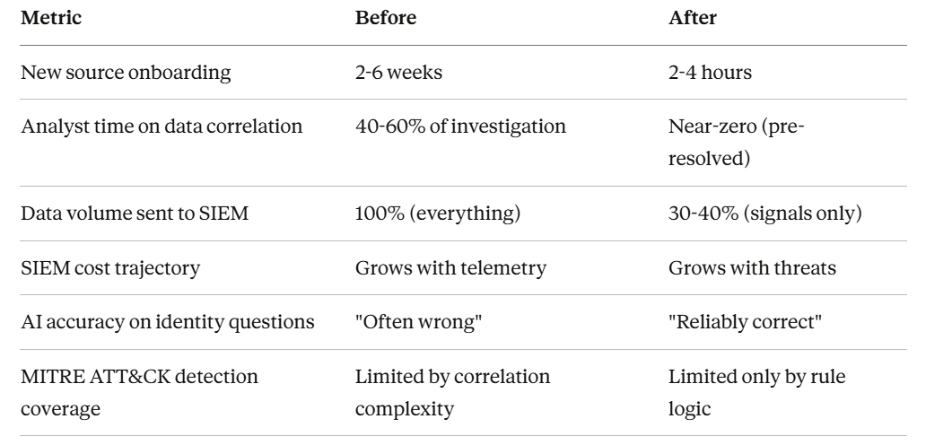
What This Looks Like in Practice

Article content

The 70% reduction in SIEM-bound data isn't about losing visibility—it's about not paying detection-tier pricing for compliance-tier logs.

More importantly: when your AI says "this user accessed these resources from this location," you can trust it—because every data point resolves to the same verified identity.

The Strategic Question for Security Leaders

Every organization will eventually build AI into their security operations. The question is whether that AI will be working with unified, trustworthy data—or fighting the same fragmentation that's already limiting your human analysts.

The SOC of the future isn't defined by which AI you choose. It's defined by whether your data architecture can support any AI you choose.

Questions to Ask Before Your Next Security Investment

Before you sign another security contract, ask these questions:

For your current stack:

  • "Can we trace a single identity across cloud, SaaS, and endpoint in under 60 seconds?"
  • "What percentage of our security telemetry actually reaches our detection systems?"
  • "How long does it take to onboard a new log source end-to-end?"

For prospective vendors:

  • "Do you normalize to open standards like OCSF, or proprietary schemas?"
  • "How do you handle entity resolution across identity providers?"
  • "What routing flexibility do we have for cost optimization?"
  • "Does this add to our data fragmentation, or help resolve it?"

If your team hesitates on the first set, or vendors look confused by the second—you've found your actual problem.

The foundation comes first. Everything else follows.

Stay tuned to the next article on recommendations for architecture of the AI-enabled SOC

What's your experience? Are your AI security tools delivering on their promise, or hitting data quality walls? I'd love to hear what's working (or not) in the comments.

Subscribe to DataBahn blog!

Get expert updates on AI-powered data management, security, and automation—straight to your inbox

Hi 👋 Let’s schedule your demo

Thank you! Your submission has been received!
Oops! Something went wrong while submitting the form.

Trusted by leading brands and partners

optiv
mobia
la esfera
inspira
evanssion
KPMG
Guidepoint Security
EY
ESI