

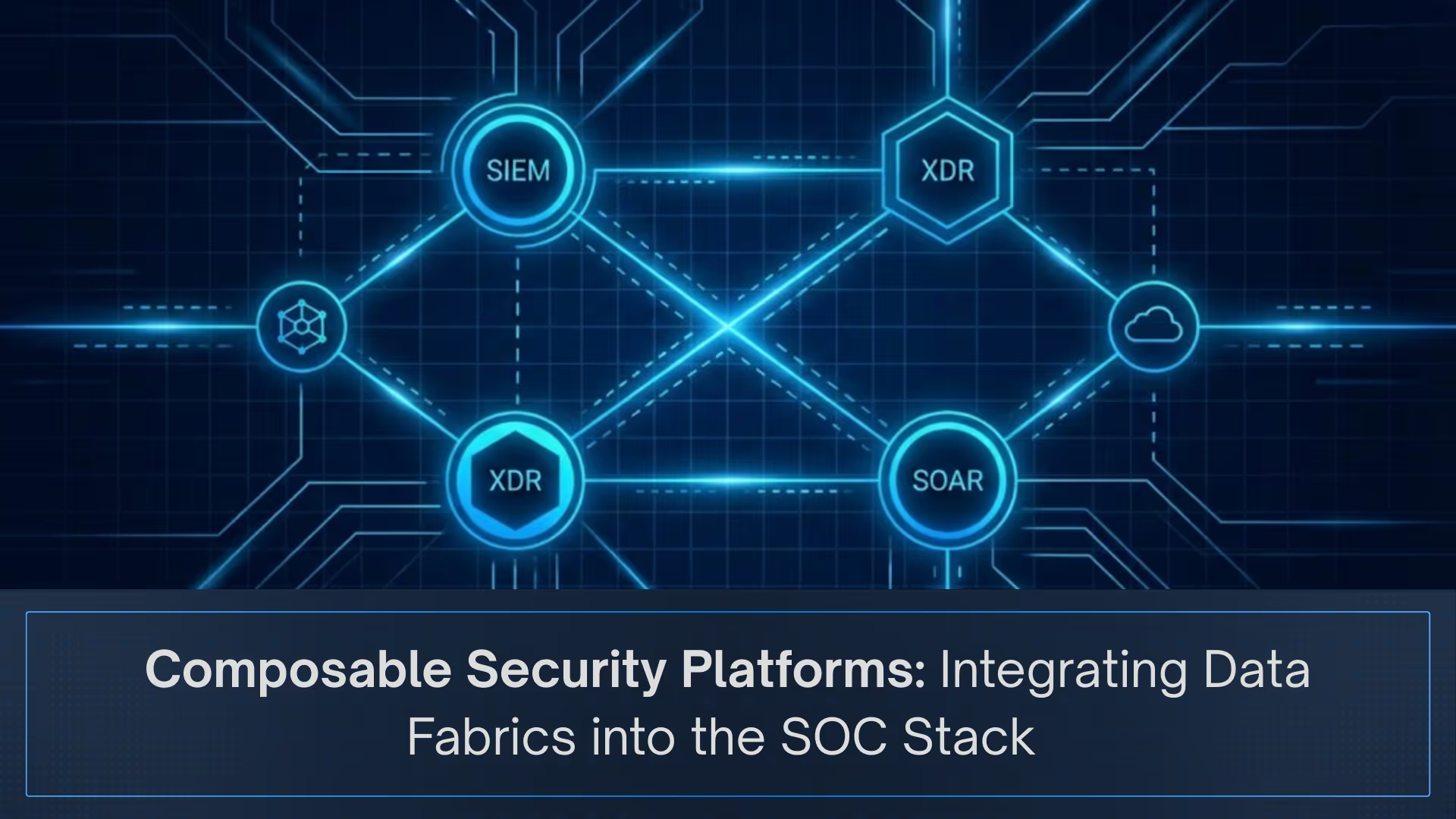


Security teams today are drowning in data. Legacy SIEMs and monolithic SOC platforms choke on ever-growing log volumes, giving analysts too many alerts and too little signal. In practice, some organizations ingest terabytes of telemetry per day and see hundreds of thousands of alerts daily, yet roughly two-thirds of alerts go uninvestigated without security data fabrics. Traditional SIEM pricing (by gigabyte or event rate) and static collectors mean escalating bills and blind spots. The result is analyst fatigue, sluggish response, and “data silos” where tools don’t share a common context.
The Legacy SOC Dilemma
Monolithic SOC architectures were built for simpler times. They assume log volume = security, so every source is dumped into one big platform. This “collect-it-all” approach can’t keep up with modern environments. Cloud workloads, IoT/OT networks, and dynamic services churn out exponentially more telemetry, much of it redundant or low-value. Analysts get buried under noise. For example, up to 30% of a SOC analyst’s time can be wasted chasing false positives from undifferentiated data. Meanwhile, scaling a SIEM or XDR to handle that load triggers massive licensing and storage costs.
This architectural stress shows up in real ways: delayed onboarding of new data feeds, rules that can’t keep pace with cloud changes, gaps in compliance data, and “reactive” troubleshooting whenever ingestion spikes. In short, agility and scalability suffer. Security teams are increasingly asked to do more with less – deeper analytics, AI-driven hunting, and 24/7 monitoring – but are hamstrung by rigid, centralized tooling.
Industry Shift: Embracing Composable Architectures
The broader IT world has already swung toward modular, API-driven design, and security is following suit. Analysts note that “the future SOC will not be one large, inflexible platform. It will be a modular architecture built from pipelines, intelligence, analytics, detection, and storage that can be deployed independently and scale as needed”. In other words, SOC stacks are decomposing: SIEM, XDR, SOAR and other components become interchangeable services instead of a single black box. This composable mindset – familiar from microservices and cloud-native design – enables teams to mix best-of-breed tools, swap vendors, and evolve one piece without gutting the entire system.
For example, enterprise apps are moving to cloud-native, service-based platforms (IDC reports ~80% of new apps on microservices.) because monoliths can’t scale. Security is on the same path. By decoupling data collection from analytics, and using standardized data contracts (schemas, APIs), organizations gain flexibility and resilience. A composable SOC can ingest new telemetry streams or adopt advanced AI models without forklift upgrades. It also avoids vendor lock-in: teams “want the freedom to route, store, enrich, analyze, and search without being forced into a single vendor’s path”.
Security Data Fabrics: The Integration Layer
This is where a security data fabric comes in. A data fabric is essentially a unified, virtualized pipeline that connects all parts of the SOC stack. As one expert puts it, a “security data fabric” is an architectural layer for collecting, correlating, and sharing security intelligence across disparate tools and sources in real time. In practice, the security datafabric ingests raw logs and telemetry from every source, applies intelligence and policies, and then forwards the curated streams to SIEMs, XDR platforms, SOAR engines or data lakes as needed. The goal is to ensure every tool has just the right data in the right form.
For example, a data fabric can normalize and enrich events at ingest time (adding consistent tags, schemas or asset info), so downstream tools all operate on the same language. It can also compress and filter data to lower volumes: many teams report cutting 40–70% of their SIEM ingestion by eliminating redundant or low-value. A data fabric typically provides:
- Centralized data bus: All security streams (network flows, endpoint logs, cloud events, etc.) flow through a governed pipeline. This single source of truth prevents silos.
- On-the-fly enrichment and correlation: The fabric can attach context (user IDs, geolocation, threat intel tags) to each event as it arrives, so that SIEM, XDR and SOAR see full context for alerting and response.
- Smart edge processing: The pipeline often pushes intelligence to the collectors. For example, context-aware suppression rules can drop routine, high-frequency logs before they ever traverse the network. Meanwhile micro-indexes are built at the edge for instant lookups, and in-stream enrichment injects critical metadata at source.
- Policy-driven routing: Administrators can define where each event goes. For instance, PCI-compliant logs might be routed to a secure archive, high-priority alerts forwarded to a SIEM or XDR, and raw telemetry for deep analytics sent to a data lake. This “push where needed” model cuts data movement and aligns with compliance.
These capabilities transform a SOC’s data flow. In one illustrative implementation, logs enter the fabric, get parsed and tagged in-stream, and are forked by policy: security-critical events go into the SIEM index, vast bulk archives into cheap object storage, and everything to a searchable data lake for hunting and machine learning. By handling normalization, parsing and even initial threat-scoring in the fabric layer, the SIEM/XDR can focus on analytics instead of housekeeping. Studies show that teams using such data fabrics routinely shrink SIEM ingest by tens of percent without losing visibility – freeing resources for the alerts that really matter.
- Context-aware filtering and index: Fabric nodes can discard or aggregate repetitive noise and build tiny local indexes for fast lookups.
- In-stream enrichment: Tags (asset, user, location, etc.) are added at the source, so downstream tools share a consistent view of the data.
- Governed routing: Policy-driven flows send each event to the optimal destination (SIEM, SOAR playbooks, XDR, cloud archive, etc.).
By architecting the SOC stack this way, teams get resilience and agility. Each component (SIEM engine, XDR module, SOAR workflows, threat-hunting tools) plugs into the fabric rather than relying on point-to-point integrations. New tools can be slotted in (or swapped out) by simply connecting to the common data fabric. This composability also accelerates cloud adoption: for example, AWS Security Lake and other data lake services work as fabric sinks, ingesting contextualized data streams from any collector.
In sum, a security data fabric lets SOC teams control what data flows and where, rather than blindly ingesting everything. The payoffs are significant: faster queries (less noise), lower storage costs, and a more panoramic view of threats. In one case, a firm reduced SIEM data by up to 70% while actually enhancing detection rates, simply by forwarding only security-relevant logs.
Takeaway
Legacy SOC tools equated volume with visibility – but today that approach collapses under scale. Organizations should audit their data pipelines and embrace a composable, fabric-based model. In practice, this means pushing smart logic to collectors (filtering, normalizing, tagging), and routing streams by policy to the right tools. Start by mapping which logs each team actually needs and trimming the rest (many find 50% or more can be diverted away from costly SIEM tiers). Adopt a centralized pipeline layer that feeds your SIEM, XDR, SOAR and data lake in parallel, so each system can be scaled or replaced independently.
The clear, immediate benefit is a leaner, more resilient SOC. By turning data ingestion into a governed, adaptive fabric, security teams can reduce noise and cost, improve analysis speed, and stay flexible – without sacrificing coverage. In short, “move the right data to the right place.” This composable approach lets you add new detection tools or analytics as they emerge, confident that the underlying data fabric will deliver exactly the telemetry you need.

.png)

.png)
.png)

