

.png)


Before starting Databahn, we spent years working alongside large enterprise security teams. Across industries and environments, we kept encountering the same pattern: the increased sophistication of platform and analytics in modernized stacks, matched by the fragility of the security data layer.
Data is siloed across tools, movement is inefficient, lineage is a mystery that requires investigation. Governance is inconsistent, and management is a manual exercise leaning heavily on engineering bandwidth not being spent on delivering clarity, but in keeping systems going despite obvious gaps. Every new initiative depended on data that was harder to manage than it should have been. It became clear to us that this was not an operational inconvenience but a structural problem.
We started Databahn with a simple conviction: that to improve detection logic, ensure scalable AI implementation, and accelerate and optimize security operations, security data itself has to be made to work. That conviction has driven every decision we have made.
This week, we shared that Databahn has grown by more than 400% year-on-year, with more than half of our customers from the Fortune 500. We are deeply grateful to the enterprises, partners, and team members who have trusted us to solve this challenge alongside them. But the growth and traction are not the headline. It is that the security ecosystem is recognizing what we saw years ago – security data is the foundation of modern security operations.
Our strategy – staying focused
As the market evolves, companies face choices about where to direct their energy. There is always pressure to broaden and extend into adjacencies, or to join up and be absorbed by larger players in the security ecosystem.
At Databahn, we remain singularly focused on solving the enterprise security data problem. Our customers and partners rely on us to be a best-of-breed solution for security data management, not a competitor attempting to replace parts of their ecosystem with new capabilities that dilute our mission.
Our belief is straightforward: enterprises don’t need another platform to own their stack, a new SIEM to detect threats, or a new Security Data Lake to store telemetry. They have these tools and have built their systems around them. What they need is a solution to make their security data work – not locked in, not siloed, not locked behind formats and schemas that take teams thousands of lines of code to uncover.
It needs to move cleanly across environments to different tools. It needs to be governed and optimized. It should support existing systems without creating friction. Building the security data system that delivers the right security data to the right place at the right time with the right context is the problem we are choosing to solve for our customers.
Enterprise adoption reflects a larger shift
The enterprises choosing Databahn are not experimenting; they are standardizing.
A Fortune 100 global airline managed a complex SIEM migration in just 6 weeks, while ensuring that complex data types – flight logs, sensors, etc. were seamlessly ingested and managed across the organization. The result was a more resilient and controlled data foundation, ready for AI deployment and optimized for scale and efficiency.
Sunrun reduced log volume by 70% while improving visibility across its complex and geographically distributed environment. That shift translated into meaningful cost efficiency and stronger signal clarity.
Becton Dickinson brought structure and governance to its security data, transforming operational complexity of a multi-SIEM deployment into clarity by centralizing their security data into one SIEM instance in just 8 weeks while significantly lowering costs.
Working with these exceptional global teams to turn security data noise into manageable and optimized signal validates our conviction. Our growth is a reflection of this realization taking hold inside the enterprise – security data isn’t working right now, but it can be made to work.
Security Data is now strategic architecture
As enterprises accelerate modernization and AI-driven initiatives, expectations placed on data have fundamentally changed. Security data is no longer exhaust, but it is infrastructure. It is the platform on which the future AI-powered SOC must operate. It must be portable, governed, observable, and adaptable to new systems without forcing architectural trade-offs.
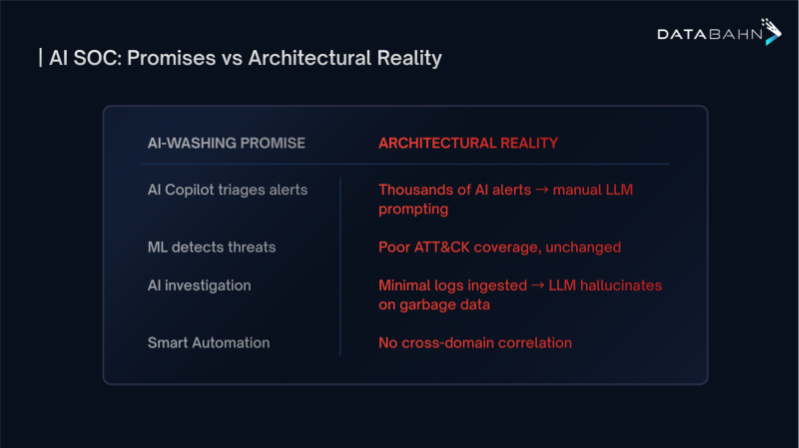
Enterprises cannot build intelligent workflows on unstable data foundations, where teams can’t trust their telemetry, and so must trust their AI output based on that telemetry even less. Before you layer more intelligence on top of your security stack, you have to fix the data foundation. That’s why AI transformation is being led by Forward Deployment Engineers who are structuring and cleansing data before adding AI solutions on top. Databahn provides that foundation as a platform, delivering flexible resiliency and governance without the manual effort and tech debt.
What comes next
We believe the next chapter of enterprise security will be defined by organizations that treat security data as a strategic asset rather than an operational byproduct. Our commitment is to continue going deeper into solving that core problem. To strengthen partnerships across the ecosystem and help enterprises modernize their security architecture without being forced into unnecessary complexity or locked into a platform that prevents ownership of their data.
The momentum we announced this week is meaningful, but it is just the beginning of a movement. What matters more is what it represents. That enterprises need to make their security data actually work.
We are excited to continue solving that challenge alongside the leaders driving this shift. The future holds many exciting new partnerships, product development, and other ways we can reduce complexity and increase ownership and value of security data. If any of these challenges seem relatable, we would invite you to get in touch with us to see if we can help.


.png)

.png)


.avif)

.avif)


