

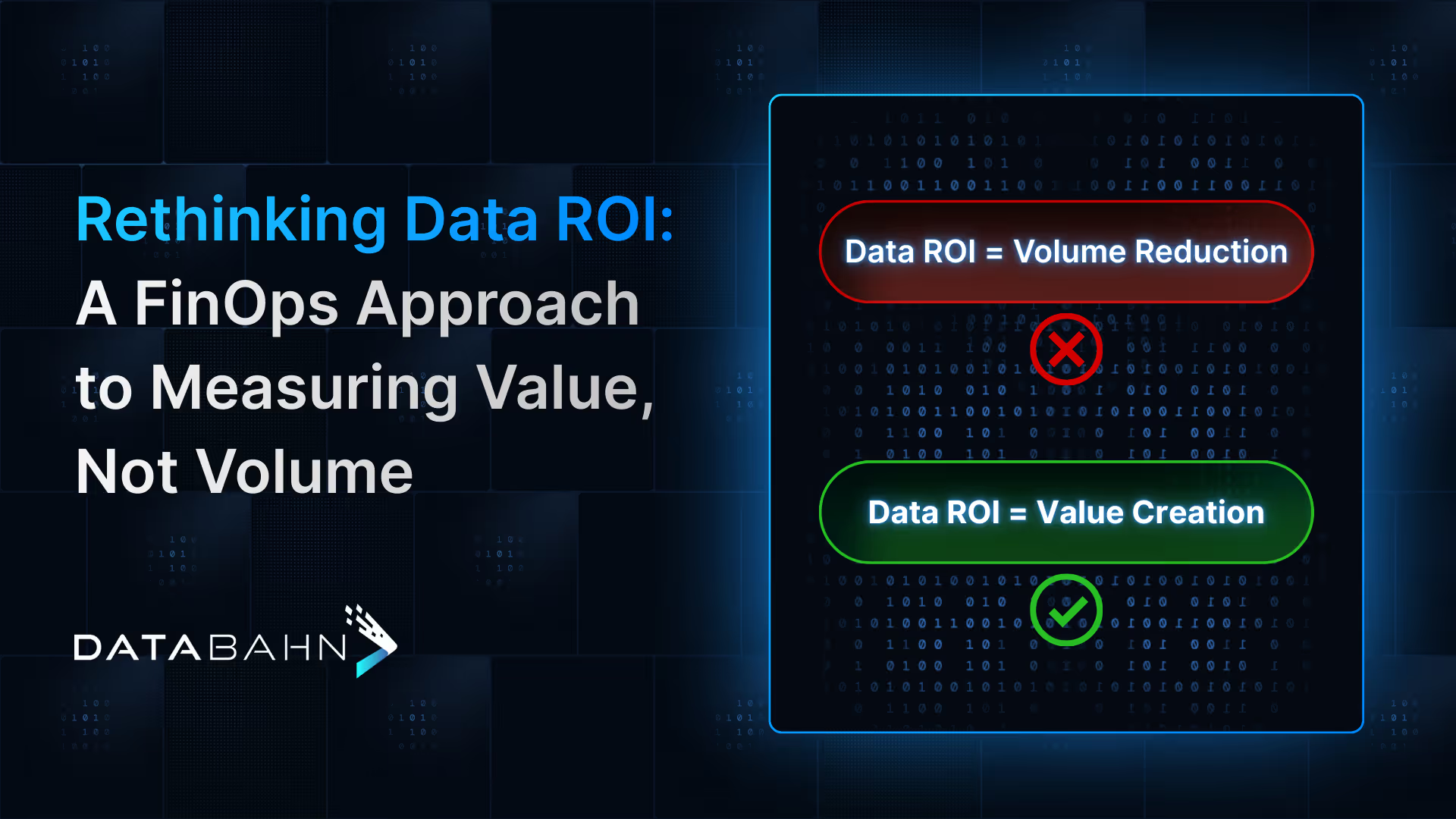


ROI is the metric that shows up in dashboards, budget reviews, and architecture discussions because it’s easy to measure and easy to attribute. Lower GB/day. Fewer logs. Reduced SIEM bills. Tighter retention.
But this is only the cost side of the equation — not the value side.
This mindset didn’t emerge because teams lack ambition. It emerged because cloud storage, SIEM licensing, and telemetry sprawl pushed everyone toward quick, measurable optimizations. Cutting volume became the universal lever, and over time, it began to masquerade as ROI itself.
The problem is simple: volume reduction says nothing about whether the remaining data is useful, trusted, high-quality, or capable of driving outcomes. It doesn’t tell you whether analysts can investigate faster, whether advanced analytics or automation can operate reliably, whether compliance risk is dropping, or whether teams across the business can make better decisions.
And that’s exactly where the real return lies.
Modern Data ROI must account for value extracted, not just volume avoided — and that value is created upstream, inside the pipeline, long before data lands in any system.
To move forward, we need to expand how organizations think about Data ROI from a narrow cost metric into a strategic value framework.
When Saving on Ingestion Cost Ends Up Costing You More
For most teams, reducing telemetry volume feels like the responsible thing to do. SIEM bills are rising, cloud storage is growing unchecked, and observability platforms charge by the event. Cutting data seems like the obvious way to protect the budget.
But here’s the problem: Volume is a terrible proxy for value.
When reductions are driven purely by cost, teams often remove the very signals that matter most — authentication context, enriched DNS fields, deep endpoint visibility, VPC flow attributes, or verbose application logs that power correlation. These tend to be high-volume, and therefore the first to get cut, even though they carry disproportionately high investigative and operational value.
And once those signals disappear, things break quietly:
- Detections lose precision
- Alert triage slows down
- investigations take longer
- root cause analysis becomes guesswork
- Incident timelines get fuzzy
- Reliability engineering loses context
All because the reduction was based on size, not importance.
Teams don’t cut the wrong data intentionally — they do it because they’ve never had a structured way to measure what each dataset contributes to security, reliability, or business outcomes. Without a value framework, cost becomes the default sorting mechanism.
This is where the ROI conversation goes off the rails. When decisions are made by volume instead of value, “saving” money often creates larger downstream costs in investigations, outages, compliance exposure, and operational inefficiency.
To fix this, organizations need a broader definition of ROI — one that captures what data enables, not just what it costs.
From Cost Control to Value Creation: Redefining Data ROI
Many organizations succeed at reducing ingestion volume. SIEM bills come down. Storage growth slows. On paper, the cost problem looks addressed. Yet meaningful ROI often remains elusive.
The reason is simple: cutting volume manages cost, but it doesn’t manage value.
When reductions are applied without understanding how data is used, high-value context is often removed alongside low-signal noise. Detections become harder to validate. Investigations slow down. Pipelines remain fragmented, governance stays inconsistent, and engineering effort shifts toward maintaining brittle flows instead of improving outcomes. The bill improves, but the return does not.
To move forward, organizations need a broader definition of Data ROI, one that aligns more closely with FinOps principles. FinOps isn’t about minimizing spend in isolation. It’s about evaluating spend in the context of the value it creates.
Data ROI shows up in:
- Signal quality and context, where complete, normalized data supports accurate detections and faster investigations.
- Timeliness, where data arrives quickly enough to drive action.
- Governance and confidence, where teams know how data was handled and can trust it during audits or incidents.
- Cross-team reuse, where the same governed data supports security, reliability, analytics, and compliance without duplication.
- Cost efficiency as an outcome, where volume reduction preserves the signals that actually drive results.
When these dimensions are considered together, the ROI question shifts from how much data was cut to how effectively data drives outcomes.
This shift from cost control to value creation is what sets the stage for a different approach to pipelines, one designed to protect, amplify, and sustain returns.
What Value Looks Like in Practice
The impact of a value-driven pipeline becomes most visible when you look at how it changes day-to-day outcomes.
Consider a security team struggling with rising SIEM costs. Instead of cutting volume across the board, they rework ingestion to preserve high-value authentication, network, and endpoint context while trimming redundant fields and low-signal noise. Ingest costs drop, but more importantly, detections improve. Alerts become easier to validate; investigations move faster, and analysts spend less time chasing incomplete events.
In observability environments, the shift is similar. Application and infrastructure logs are routed with intent. High-resolution data stays available during incidents, while routine operational exhaust is summarized or routed to lower-cost storage. Reliability teams retain the context they need during outages without paying premium rates for data they rarely touch. Mean time to resolution improves even as overall spend stabilizes.
The same pattern applies to compliance and audit workflows. When privacy controls, lineage, and routing rules are enforced in the pipeline, teams no longer scramble to reconstruct how data moved or where sensitive fields were handled. Audit preparation becomes predictable, repeatable, and far less disruptive.
Across these scenarios, ROI doesn’t show up as a single savings number. It shows up as faster investigations, clearer signals, reduced operational drag, and confidence that critical data is available when it matters.
That is the difference between cutting data and managing it for value.
Measuring Success by Value, Not Volume
Data volumes will continue to grow. Telemetry, logs, and events are becoming richer, more frequent, and more distributed across systems. Cost pressure is not going away, and neither is the need to control it.
But focusing solely on how much data is cut misses the larger opportunity. Real ROI comes from what data enables: faster investigations, better operational decisions, predictable compliance, and systems that teams can trust when it matters most.
Modern Data Pipeline Management reframes the role of pipelines from passive transport to active value creation. When data is shaped with intent, governed in motion, and reused across teams, every downstream system benefits. Cost efficiency follows naturally, but it is a byproduct, not the goal.
The organizations that succeed in the FinOps era will be those that treat data as an investment, not an expense. They will measure ROI not by the terabytes they avoided ingesting, but by the outcomes their data consistently delivers.

.png)

.png)
.png)


.avif)

.avif)


